
What the painting wants to become
March 22, 2026
For most of my life, I knew exactly how to get things done: decide what to do, make commitments to hold yourself accountable, and then deliver as promised on time. Any step that didn't lead toward the final result was noise.
In fact, I didn't think there was any other way. It had worked for everything: sports, business, education, projects around the house... life.
I was not expecting such proven habits to become counter-productive in my new creative life.
At first, I didn't notice. I had become a full-time student, and the result-oriented thinking still served me well. I only realized I needed a new way of thinking when I started to free up time for my own practice.
I had expected I would define a destination for each practice area: a novel with a clear message, a song that conveys a strong feeling, and so on. Then announce the "projects" and report back in my newsletter.
I had plenty of exciting early stage ideas but, coming to planning and definition, none felt unique or strong enough to justify the massive effort. Nothing seemed good enough to start.
In one of my courses, the professional artist described his process. He would just start, put some color on the canvas, and explore "what the painting wants to become." Sometimes he could have a certain intention, but the painting would often end up as something completely different.
At that point, I was not yet receptive to this concept. I probably dismissed it as some kind of cheating: you can only draw if you can successfully translate your inner picture to paper. If you have no upfront intention, no purpose for the final work, then why spend the time?
However, over time more and more signs pointed in the same direction. Marguerite Duras writes in her book Writing: "Writing is trying to know beforehand what one would write if one wrote, which one never knows until afterward."
She is saying something close to what the artist described — but sharper. You try to know what you will write before you write it, and you never manage it. The knowing only ever arrives afterward. The attempt is not a failure of preparation; it is what writing actually is.
Duras elaborates further. "If one had any idea what one was going to write, before doing it, before writing, one would never write. It wouldn't be worth it anymore."
In other words, Duras is saying the not-knowing is not a problem to solve before you start — it is what makes starting worth doing at all. If the outcome were already decided, there would be no reason to write it.
When I remove the urge to define an outcome in advance, things definitely get produced. The outcomes are not always what I expected, but real nonetheless.
This shift forced me to reconsider what used to be sound habits. A small example is the trusted to-do list and schedule for the day. In my creative practice, they just hamper creativity and disrupt flow.
Working in discovery mode means there is no direct correlation between effort and outcome. You might write a whole chapter and then discard it. An outcome-based to-do list is not the right tool in this context.
I dropped both the to-do list and the day schedule. But I still wanted something that encourages and tracks "doing the right thing" rather than checking boxes for outcomes. Something that could also help me see when it's time to call it a day. Working is rewarding and often I can't help wanting to just keep going.
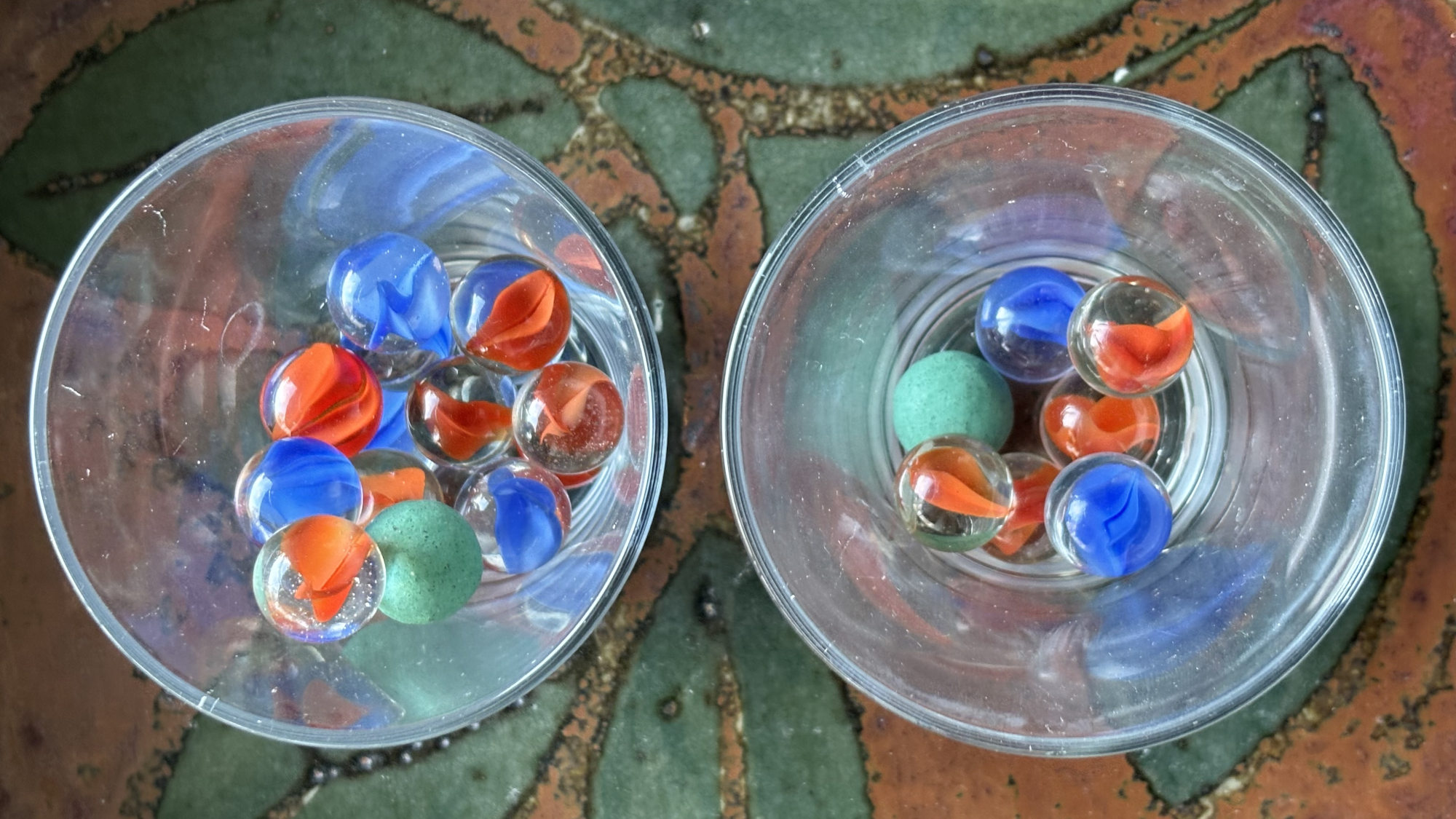
Here is what I came up with: I let each marble in a glass represent about fifteen minutes of intentional, focused, high-quality creative time.During the day I move marbles from one glass to another. When I run out of marbles in the first glass, I know I can call it a day. Even if I have nothing to show for it.
It's like the opposite of a to-do list: a done-list without specified items.
Improving ability is my overall goal so it is an ever moving target. I experience, measure and celebrate progress. But there is no final finish line to cross.
Tangible outcomes appear regularly and some are keepers: a short story, a song, a drawing. But these deliverables are byproducts of the learning process. They are never carefully considered or intended to be the result needed to define me. The deliverable is no longer the main point.
Haruki Murakami addresses this in Novelist as a Vocation when he talks about his first book (Hear the Wind Sing):
"I had no thought at all that ordinary readers would ever see it, and all I thought about as I wrote it was that writing made me feel good. Taking some images I had inside me, choosing words that satisfied me, putting those words together into sentences."
For Haruki Murakami, the process was the point. The book came about as a byproduct of the pleasure of writing. He was not even thinking about readers.
I used to think everything started with deciding what to do and why. It turns out that, at least for me, creative work starts with making something. When I keep doing that, something real emerges.